TL;DR:
Have you ever tried transferring photos from your iPhone to a Windows PC, or uploading an image to an online application, only to be met with a frustrating "unsupported file format" error? If your images suddenly end in .heic instead of the familiar .jpg, you are encountering Apple's modern compression standard. While HEIC is a massive technological leap forward, the universal compatibility of JPEG still rules the digital world.
This comprehensive guide breaks down the ultimate HEIC vs JPEG showdown, analyzes their pros and cons, and provides the best solution to bridge the cross-platform gap without losing your precious image quality.
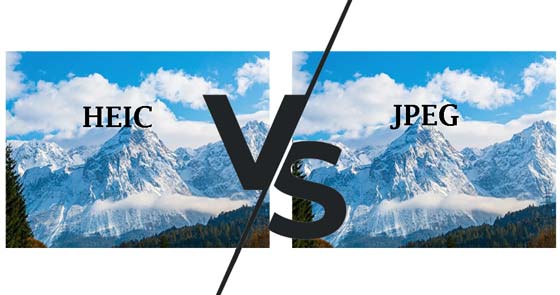
To understand why this choice matters, we need to compare how these formats compress data, handle image quality, and behave across different platforms.
| Feature | HEIC (HEIF) | JPEG (JPG) |
|---|---|---|
| Compression Standard | HEVC / H.265 (Modern) | DCT (Legacy, 1992) |
| File Size | ~50% smaller than JPEG | Standard size |
| Color Depth | 10-bit (1.07 Billion Colors) | 8-bit (16.7 Million Colors) |
| HDR Support | Yes (Native) | No |
| Advanced Features | Transparency, Live Photos, Depth Maps | Basic single-layer image |
| Compatibility | Limited (Apple native, requires plugins for Windows) | Universal (Works everywhere) |
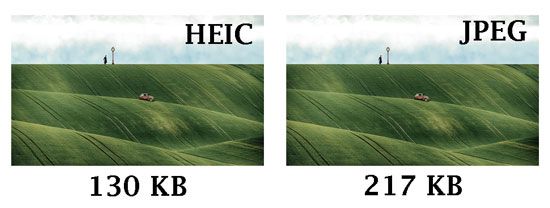
HEIC relies on the modern HEVC (High Efficiency Video Coding) compression standard. Because of this, an HEIC photo takes up approximately half the storage space of a JPEG with the exact same visual quality. If a typical JPEG photo takes up 3 MB, the HEIC version will only take up around 1.5 MB. For anyone managing a 128GB or 256GB phone, this effectively doubles your photo storage capacity.
Don't let the smaller file size fool you-HEIC delivers significantly better image data. JPEG is constrained to an 8-bit color depth, capping it at 16.7 million colors. HEIC supports 10-bit color depth, unlocking over 1 billion colors. Furthermore, HEIC natively preserves Highlights and Shadows (HDR data), which prevents color banding in gradients like sunsets or clear skies.
Unlike JPEG, which only saves a single flat image layer, HEIC is a "container." This allows it to hold multiple images and data types in a single file, including:
Despite its technical superiority, HEIC has one massive flaw: compatibility.
While Apple devices handle HEIC perfectly, the rest of the tech world has been slow to fully adopt it.
This cross-platform friction means you will eventually need to change your HEIC files back to JPEG to get anything done.
This is where JPEG wins - and it's not even close.
| Platform | HEIC Support | JPEG Support |
|---|---|---|
| Apple devices (iOS, macOS) | Native | Native |
| Windows 10/11 | Requires HEIF extensions | Native |
| Android 9+ | Native | Native |
| Older Android | Not supported | Native |
| Web browsers | Safari 17+ only | All browsers |
| Photo editing software | Limited | All software |
| Email/Sharing | May not open | Works everywhere |
Outside Apple platforms, only Safari 17+ opens HEIC natively - Chrome, Firefox, and Edge do not. HEIC is not supported by all major browsers, especially in web environments where JPEG, PNG, and WebP remain dominant.
This compatibility gap is the #1 reason users need to convert HEIC to JPEG. You can't reliably:
While you can change your iPhone settings to force it to shoot in JPEG (Settings > Camera > Formats > Most Compatible), this will cause your future photos to consume twice as much space, and it won't fix the hundreds of HEIC photos you've already taken.
The most efficient solution for dealing with existing files is using a dedicated desktop batch converter. This is where Coolmuster HEIC Converter comes into play.
Coolmuster HEIC Converter is a lightweight, secure utility designed to handle mass image conversions without sacrificing your image quality.
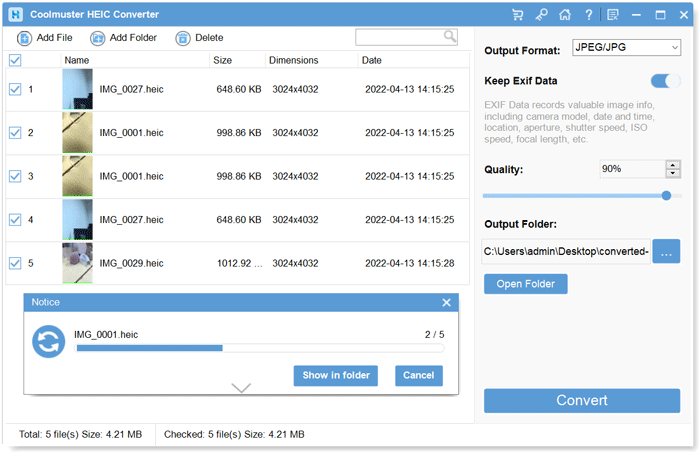
01Download, install, and launch Coolmuster HEIC Converter on your Windows PC or Mac.
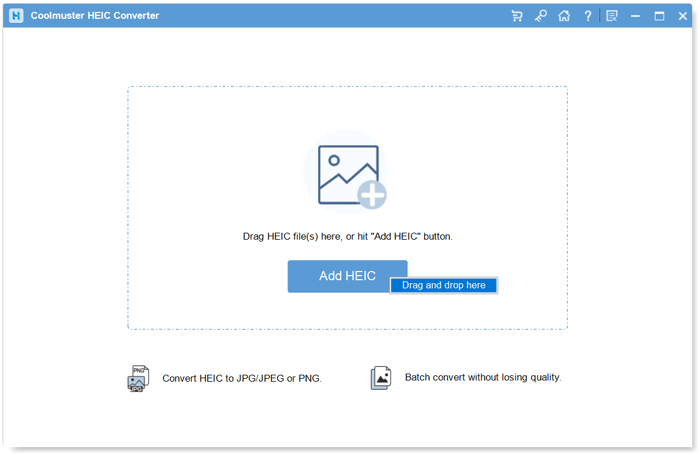
Click the Add HEIC button, or simply drag and drop your .heic files or entire folders directly into the program window.
02Move to the right-hand settings panel. Under the Format drop-down menu, select JPG/JPEG.
Ensure the Keep EXIF Data box is checked to preserve your photo timestamps. Adjust your preferred output path and target quality (90%–100% is recommended for crystal-clear results).
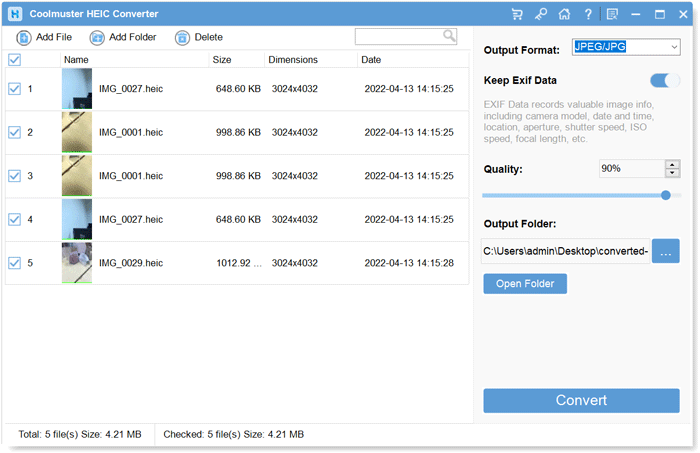
03Click the Convert button. The software will process your batch in seconds, leaving you with universally compatible JPEGs ready for any platform.
Video Guide:
No. HEIC photos take up roughly 50% less storage space than JPEGs while maintaining equivalent or superior visual quality.
If your computer features a modern HDR monitor, HEIC files will look noticeably cleaner than JPEGs. This is because HEIC supports 10-bit color depths and natively holds high dynamic range metadata, preventing the color compression and pixelated artifacting common in standard 8-bit JPEGs.
Most modern Android devices running Android 10 or later can open and view HEIC files natively. However, trying to share them through messaging apps or editing them in older Android applications may still trigger compatibility issues. See how to convert HEIC to JPG on Android here if needed.
Because JPEG uses a lossy compression algorithm, a tiny amount of data is technically discarded during conversion. However, if you use a high-quality desktop tool like Coolmuster HEIC Converter and set the quality slider to 95% or 100%, the difference will be completely imperceptible to the human eye.
Yes, in terms of compression and image quality. HEIC files are roughly 50% smaller than JPEGs at the same visual quality, support 16-bit color depth (vs JPEG's 8-bit), and offer features like transparency and Live Photos. However, JPEG is better for compatibility - it works everywhere.
Yes. Go to Settings > Camera > Formats and select "Most Compatible" instead of "High Efficiency." This will save photos as JPEG. Keep in mind that JPEG files will be larger and take up more storage space.
No. HEIF means the High-Efficiency Image File Format, which stored images in smaller sizes but keeps the high-definition image quality. It can capture all the extended dynamic ranges offered by the camera's 10- or 12-bit color output.
HEIC is a variant of HEIF that Apple chooses for naming the file format and shares similar features as HEIF. Actually, Apple does not create HEIC. Instead, it is created by the MPEG group, which also creates AAC and other popular codecs. (For more info, go to check HEIF vs. HEIC)
Both HEIC and JPEG formats can store EXIF metadata, which contains details about the photo. This includes information like the date and time the photo was taken, the location (if GPS is enabled), and camera settings such as exposure. The metadata is embedded directly by the camera when the photo is taken.
By the end of the article, you may distinguish HEIC V.S. JPEG. Although JPEG is a more widely compatible image format, HEIC is still popular among iOS users for its small size and high quality. As for which format is best for you, you can consider it according to your demands.
If you adopt HEIC finally, you can convert HEIC to JPEG with Coolmuster HEIC Converter. If you have any queries while using, please leave a comment below.
Related Articles:
Best HEIC to JPG Converter on Windows/Mac/Online
4 Best Ways to Convert HEIC to JPG/JPEG in Google Photos
A Complete Guide on iMazing HEIC Converter Review & Its 7 Alternatives
How to Convert HEIC to PNG Online or Offline? (6 Simple Methods)





 Free Download for PC
  Free Download for Mac


