Whether your deleted photos are professional shots or candid family moments, it's urgent and important to recover them. Because JPG and JPEG files are the most common formats for digital imagery, they are also the most frequently deleted by accident. The good news is that "deleted" doesn't always mean "gone". Go ahead to recover deleted JPG/JPEG files with 5 useful methods.
The moments immediately following a deletion are critical for recovery success. When you delete a file, the computer doesn't actually erase the data; it simply marks the space as "available" for new information.
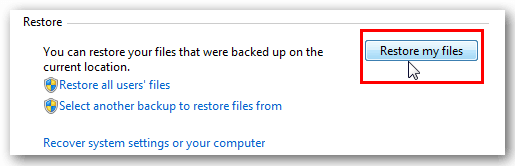
Even on Windows 10 and 11, the "Backup and Restore (Windows 7)" feature remains a reliable way to retrieve files if you had a system image or backup configured. But if you haven't backed up your photos with this feature, you cannot restore your JPG/JPEG images with this feature.
Here's how to restore JPG/JPEG images with the Backup and Restore (Windows 7) feature:
Step 1: Open "Control Panel" and navigate to "System and Security" > "Backup and Restore (Windows 7)".
Step 2: Click "Restore my files", and browse for the folders or specific JPEG files you need to recover.
Step 3: Choose whether to restore them to their original location or a new folder. Follow the prompts to complete the restoration.
If you don't have any backup of your JPG and JPEG photos, you can use Coolmuster Data Recovery. This user-friendly program can recover your deleted pictures from your PC or other storage devices without backup. Besides, it can sort out images by format. It is particularly effective for scanning and recovering data from external hard drives, USBs, SD cards, etc.
Highlights of Coolmuster Data Recovery:
Download Coolmuster Data Recovery.
To recover deleted JPG/JPEG pictures with this software:
01Launch the software after installing it, and select the "Deleted Recovery" mode.
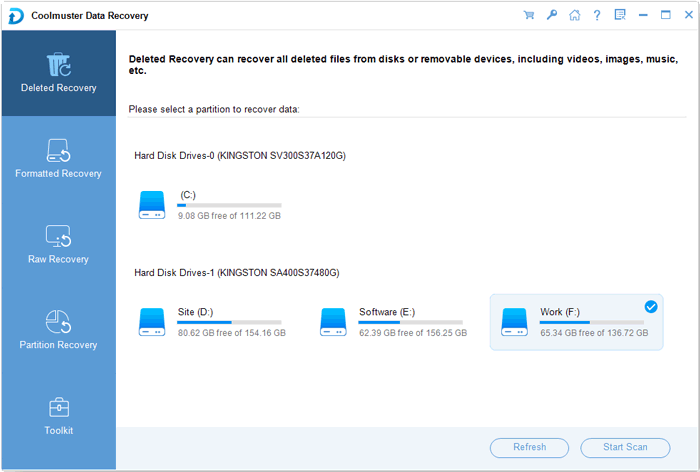
02Select the partition or drive where your pictures were stored and click "Start Scan".
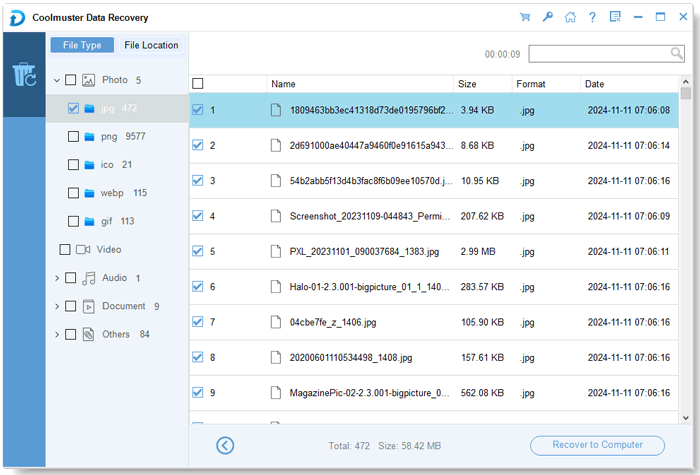
03Once the scan is complete, use the file type filter to look specifically for "JPG". Select your desired files, and hit "Recover to Computer".
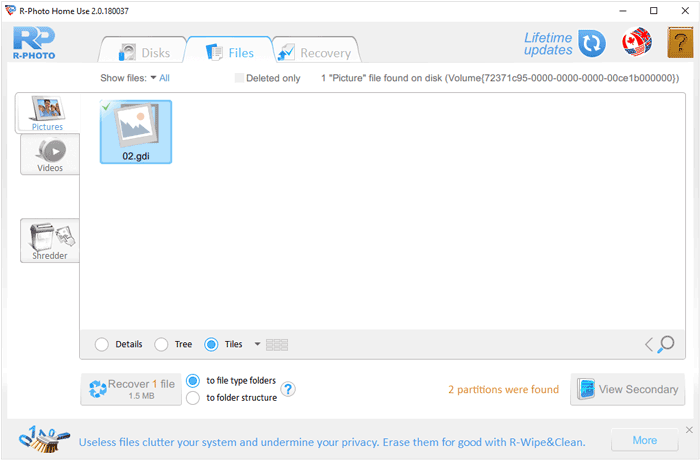
R-Photo is a free, specialized tool designed specifically for photo and video recovery. It is lightweight and supports various file systems like NTFS and FAT32, so you can use it to recover your JPG/JPEG files from hard drives and external memory cards.
Here's how to recover deleted JPG/JPEG images with R-Photo:
Step 1: Download and install R-Photo on your computer. Then open R-Photo and select the disk containing your deleted images.
Step 2: Click "Show Files". The software will quickly sort through the drive. Then use the Search/Filter bar to type ".jpg" or ".jpeg" to narrow down the results.
Step 3: Right-click the desired images to preview them. If they look good, select them and click "Recover".
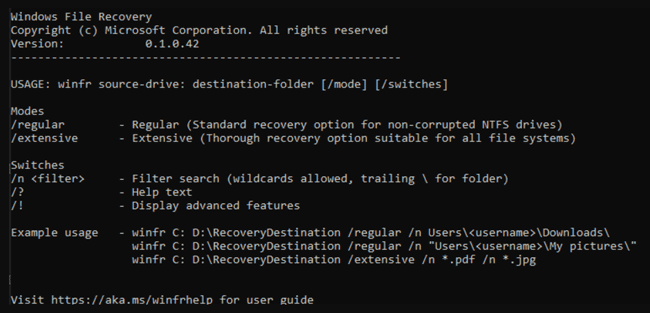
For users comfortable with a command-line interface, Microsoft offers "Windows File Recovery" via the Microsoft Store. This is a powerful, official tool for deep-level recovery.
Here's how to retrieve deleted JPG/JPEG photos with Windows File Recovery:
Step 1: Download and open Windows File Recovery on your PC, and open Command Prompt as Administrator.
Step 2: Use the following syntax in the command prompt: winfr source-drive: destination-folder: /regular /n *.jpg (Example: winfr C: D:\RecoveryFolder /regular /n *.jpg).
Step 3: This command tells the system to scan the C: drive for all JPG files and save them to a folder on the D: drive. Type "Y" to start the process.
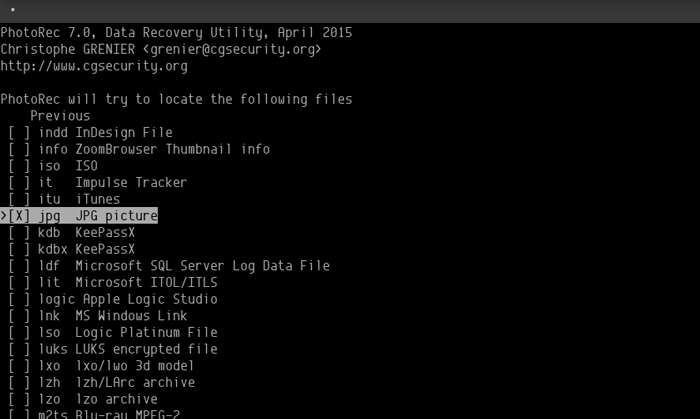
PhotoRec is an open-source recovery tool. While it lacks a graphical "pointing and clicking" interface, it is one of the most powerful tools for recovering files from severely corrupted media, including JPG and JPEG images.
Here's get deleted JPG/JPEG files back with PhotoRec:
Step 1: Run "photorec_win.exe" as an administrator, then select the drive you want to scan using the arrow keys, and press "Enter".
Step 2: Select the partition and the file system type (usually FAT/NTFS). In the "File Opt" settings, ensure "JPG" is selected as a target format.
Step 3: Choose a destination to save the recovered files (always choose a different drive than the one being scanned) and press "C" to begin the recovery.
By acting quickly and choosing the appropriate recovery method, you can significantly increase your chances of recovering your deleted JPG/JPEG files. Built-in options like Windows Backup are ideal if you've prepared in advance, while tools like Coolmuster Data Recovery, R-Photo, Windows File Recovery, and PhotoRec offer powerful alternatives when backups are unavailable.
Besides, for non-tech-savvy users, Coolmuster Data Recovery provides a reliable data recovery feature and an easy-to-use interface. No skill is needed. Anyway, to minimize future risks, consider implementing regular backups for your important files. Prevention is always more reliable than recovery.
Related Articles:
How to Recover Deleted Photos from SD Card on Android Phone? [Fixed]
How to Convert HEIC to JPG on Google Drive - 4 Effective Ways







 Free Download for PC
  Free Download for Mac


