"I have accidentally deleted some files which I wasn't meant to I went to go look in my recycle bin if it was there but I had emptied that as well. Is there any way I could get these files back as they are quite important for me."
- From Microsoft Community
Data loss is a common issue for laptop users. Files may disappear due to accidental deletion, system crashes, virus attacks, disk formatting, or hardware failure. Fortunately, modern laptop data recovery software can often retrieve lost files from hard drives, SSDs, USB drives, and memory cards. Read on, and learn about 12 data recovery apps for computers.
Part 1: Laptop Data Recovery Software for Windows and Mac
Losing important files from your laptop can be frustrating, but don't worry - there are effective tools that can help you regain your data.
1.1 Coolmuster Data Recovery
If files are not in the Recycle Bin or Trash, they may have been permanently deleted. In this case, Coolmuster Data Recovery is a powerful tool to help recover lost files on both Mac and Windows. It can deeply scan your entire laptop hard drive and robustly retrieve files from your MacBook or Windows laptop within minutes.
Restore deleted data from USB flash drives, digital cameras, memory cards, iPods, MP3/MP4 media players, and other portable devices, as well as removable storage devices.
Fully recover over 550 file formats, including photos, videos, music, documents, emails, .zip files, and more.
Work well for data recovery after formatting, deletion, and loss on both Mac and Windows computers.
Preview the details of your files in advance before data recovery.
Perform read-only operations to retrieve and recover your target files, in order to avoid further damage to your computer and data.
Compatible with Windows 11/10/8/7, and Mac OS X 10.7 - 10.15.
You can get a free trial version of Data Recovery right now to experience its functions in advance.
Extremely intuitive interface that requires almost no learning curve.
Reliable for standard document and photo recovery.
Can recover files from laptops, external hard drives, USB flash drives, SD cards, and other storage media.
Allow preview before restoring them.
Support various file formats.
Cons:
The free version serves primarily as a demo for scanning.
May struggle with heavily corrupted drives.
License pricing:
Lifetime license: $69.95
Here's how to use this laptop data recovery software to recover deleted files:
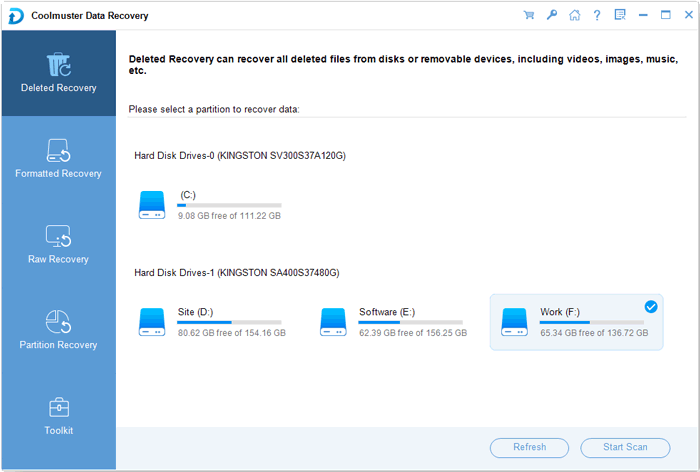
01After downloading and installing the recovery program on your PC, launch it and select a recovery mode in the primary window to begin the process. To retrieve data from a laptop, you can choose the "Deleted Recovery" mode as a try.
02The software will automatically detect and show all the partitions on your laptop. Just choose the partition where your lost files were originally located and click the button "Start Scan" to scan for lost files.
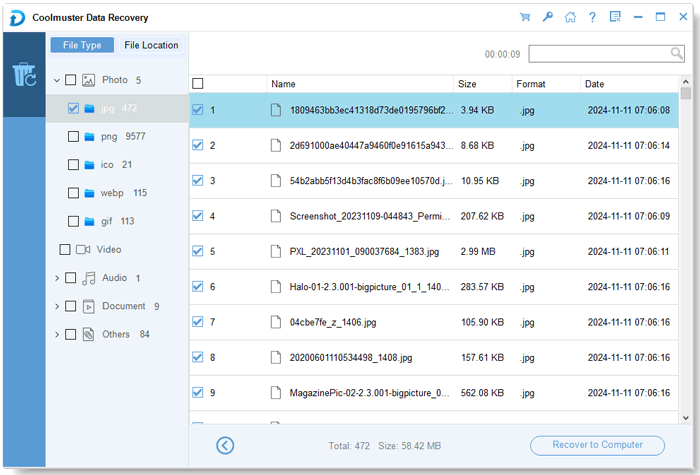
03After a few while when the scan finishes, all the scanned-out contents will be found and shown in categories. You are allowed to preview the found files one by one to confirm which are the ones you want to recover.
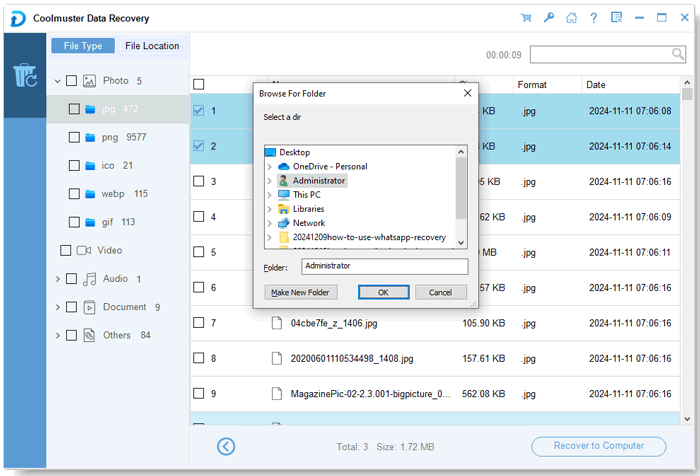
04Mark those files you want to recover and click the "Recover to Computer" button to bring out the "Path" dialog box. Choose an output folder where you want to save the recovered data and then the recovery will begin. Please note that you should choose another partition to save the recovered data instead of the original one where you lost them.
You can watch the video guide (about 2 minutes):
1.2 Disk Drill Data Recovery
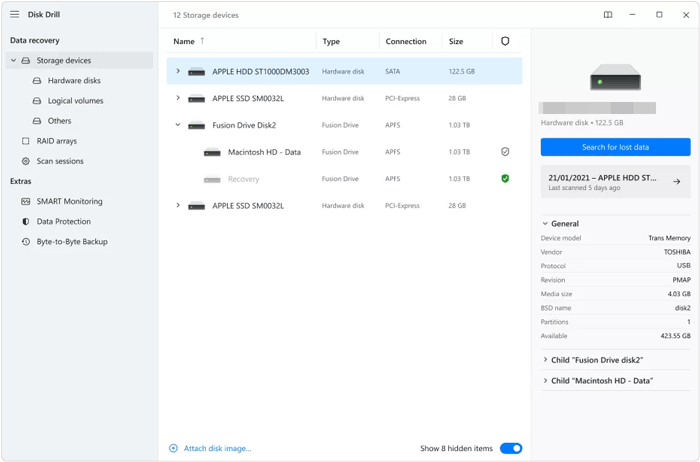
Disk Drill is a powerhouse in the industry, favored for its sleek design and advanced recovery algorithms. It supports hundreds of file formats and includes extra features like "Recovery Vault" to prevent future data loss.
Key features:
Deep scan algorithms for complex recovery cases.
File preview capability.
Recovery Vault data protection feature.
Support over 400 file formats.
Pros:
Excellent "Recovery Vault" feature to protect against future loss.
Best-in-class user interface.
Data protection features like Recovery Vault and S.M.A.R.T. monitoring to prevent future data loss.
Cons:
The free version only allows recovery of a small amount of data.
Full version relatively expensive for occasional users.
License pricing:
Basic version: Free (Up to 500MB recovery on Windows)
One-year subscription: $89
Lifetime license: $149
1.3 Recuva Data Recovery
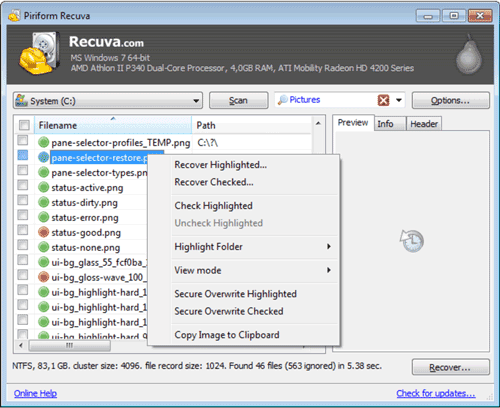
For Windows users looking for a free or low-cost solution, Recuva remains a staple. Developed by the creators of CCleaner, it is lightweight and effective for simple file undeletion from hard drives and memory cards.
Key features:
Quick scan for recently deleted files.
Deep scan for more complex recovery.
Portable version available.
Simple interface suitable for beginners.
Pros:
Provide a completely free version is available for basic recovery tasks.
Include a portable version that runs from a USB (preventing data overwriting).
Very easy to use, especially for recovering recently deleted files.
Cons:
Limited recovery capabilities for complex data loss situations.
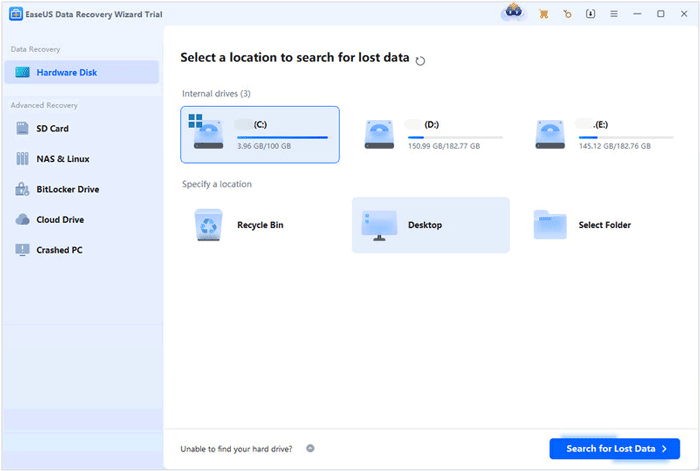
EaseUS is often cited for its high success rate. Its "Wizard" approach guides users through a three-step process: Select, Scan, and Recover. It is particularly adept at handling formatted partitions.
Key features:
Allow you to create a WinPE emergency disk to recover data when the laptop fails to boot into Windows/macOS.
Specialized support for recovering data from Network Attached Storage (NAS) devices.
Automatically repairs corrupted JPEG/JPG photos and MP4/MOV videos found during the scan.
Pros:
Very high success rate for formatted partitions.
Incredibly fast scanning speeds on modern NVMe SSDs.
Recover while scanning feature, allowing faster file retrieval.
Cons:
Subscription-based pricing can be costly over time.
Frequent "upgrade" pop-ups in the interface can be intrusive.
License pricing:
One-month license: $69.95
One-year license: $99.95
Lifetime license: $149.95
1.5 R-Studio
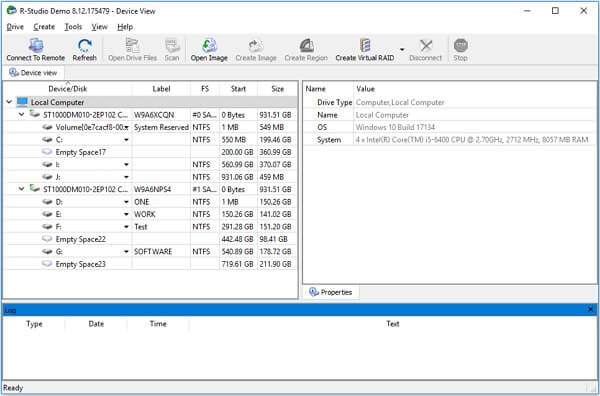
Unlike "wizard-style" apps, R-Studio is a professional-grade tool designed for heavy-duty data recovery and forensic work. It excels at recovering data from heavily damaged or unknown file systems.
Key features:
Advanced algorithms to virtually rebuild failed RAID 0, 1, 4, 5, and 6 arrays.
Can recover data from a laptop connected via a local network or the internet.
Includes a built-in professional hex editor to manually inspect and edit disk sectors.
Pros:
Professional-grade recovery features, including RAID reconstruction and network recovery.
Supports multiple operating systems (Windows, macOS, and Linux).
Works with many file systems, including NTFS, APFS, EXT4, and HFS+.
Cons:
Steep learning curve for beginners due to its complex interface.
The interface is cluttered with technical jargon that may intimidate casual users.
Higher price compared with consumer tools.
License pricing:
R-Studio (Standard): $79.99 (supports all file systems).
R-Studio NTFS: $59.99 (limited to specific file systems).
R-Studio FAT: $49.99 (limited to specific file systems).
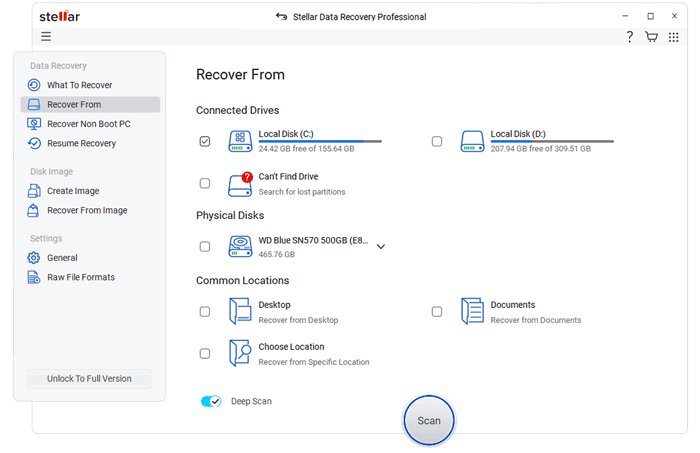
The Stellar computer data recovery provides a suite of tools ranging from basic file recovery to specialized repair for corrupted photos and videos. It is widely recognized for its reliability in corporate environments.
Key features:
Optimized for professional setups, allowing you to track scans and results across two screens.
Specialized support for recovering data from scratched or damaged CDs, DVDs, and Blu-ray discs.
Creates a replica of a drive to prevent further wear on a physically failing laptop HDD.
Pros:
ISO-certified for security.
Include unique tools to repair corrupted video and photo files after recovery.
Great BitLocker support.
Cons:
Advanced features (like RAID or Video Repair) are locked behind higher, more expensive tiers.
The scanning process can be slow on large drives.
License pricing:
Standard: $59.99/year
Professional: $89.99/year
Premium: $99.99/year
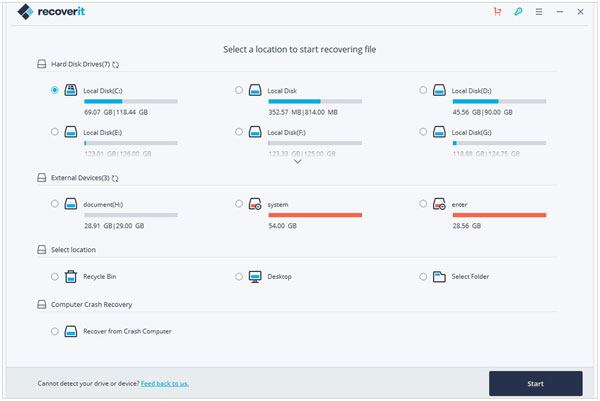
1.7 Wondershare Recoverit
Recoverit stands out for its ability to recover data from crashed computers. It creates a bootable USB drive to help you access files even when your laptop won't start.
Key features:
Scan, gather, and match fragments of ultra-high-definition videos (4K/8K) to ensure they are playable.
Provide 1 dedicated module for creating a bootable drive to rescue data from a "blue screen" or "black screen" laptop.
Broad compatibility ranging from internal SSDs to action cameras and drones.
Pros:
Exceptional at "stitching" together fragmented 4K/8K video files.
Support recovery from over 2,000 types of storage devices.
Modern and beginner-friendly interface.
Cons:
Expensive subscription plans compared to competitors.
The free version only allows scanning and previewing - no actual data recovery.
License pricing:
Monthly plan: $59.99
Annual plan: 69.99
Perpetual plan: $129.99
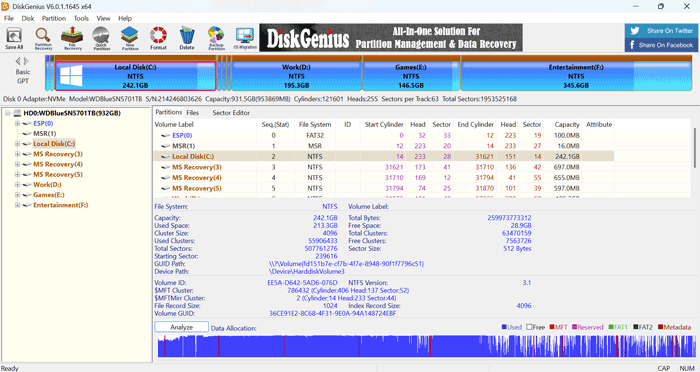
1.8 DiskGenius
DiskGenius is a multi-functional tool that combines data recovery with partition management. It is an excellent choice for users who need to repair partition tables while also retrieving lost files.
Key features:
Can resize, extend, or split partitions in addition to recovering lost ones.
Includes tools to check and repair logical bad sectors on a hard drive.
Can load virtual disk files (VMWare, VirtualBox) and recover data from within those environments.
Pros:
A "Swiss Army Knife" that includes partition resizing, disk cloning, and hex editing alongside data recovery.
Good performance for partition table reconstruction.
Useful for IT professionals managing storage devices.
Cons:
Interface can appear complex to beginners.
Windows-focused with limited cross-platform support.
License pricing:
One-month license: $69.90
One-year license: $99.90
Lifetime license: $129.90
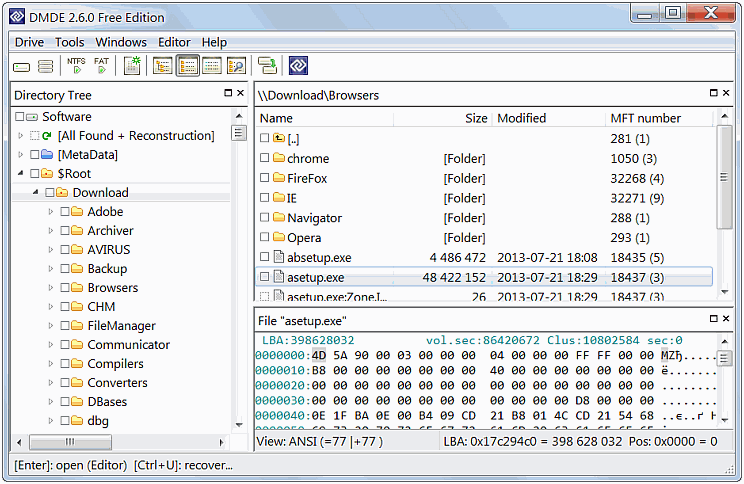
1.9 DMDE
DMDE (Data Management & Disk Editor) is a specialized tool for searching, editing, and recovering data on disks. While its interface is technical, its ability to reconstruct complex directory structures is top-tier.
Key features:
Uses unique algorithms to rebuild the original directory structure even when the file system is severely damaged.
Allows for low-level sector editing and navigation using a variety of templates.
A manual tool for professionals to define parameters for complex broken RAID systems.
Pros:
Provide granular control over disk clusters and directory structures.
Affordable pricing compared to many competitors.
Allow manual editing of disk structures.
Cons:
Very technical "manual" feel.
Easy to make mistakes if you aren't familiar with disk geometry.
No file preview for videos.
License pricing:
Express (One Year): $20
Standard (Perpetual): $48
Professional: $99 (1-OS Family) or $133 (Multi-OS)
1.10 PhotoRec
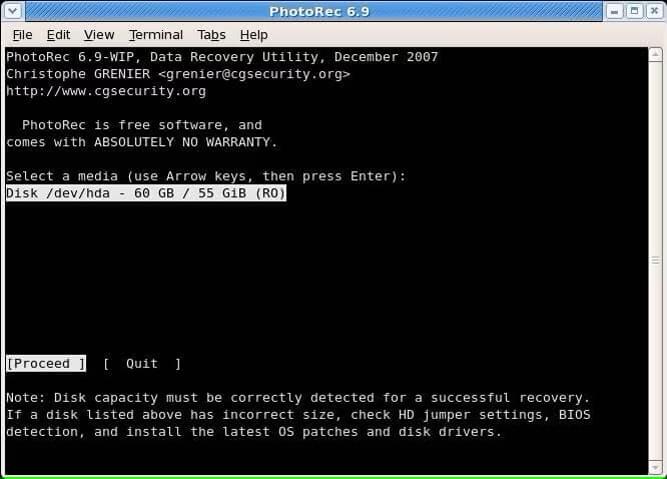
PhotoRec is an open-source, text-based recovery tool. While it lacks a modern graphical interface, it is incredibly powerful at "carving" data out of disks, ignoring the file system entirely to find underlying signatures.
Key features:
Completely ignore the file system and search for raw data "signatures" (e.g., the specific code that identifies a PDF or JPG).
Run on everything from Windows and macOS to Sun Solaris and even old DOS systems.
Completely free with no hidden limits on the amount of data recovered.
Pros:
Completely free and open-source.
Work on virtually any OS.
Ignore the file system to find raw data "signatures" on damaged disks.
Cons:
No graphical user interface (command-line only).
Cannot recover original filenames or folder structures.
1.11 Veeam Data Platform
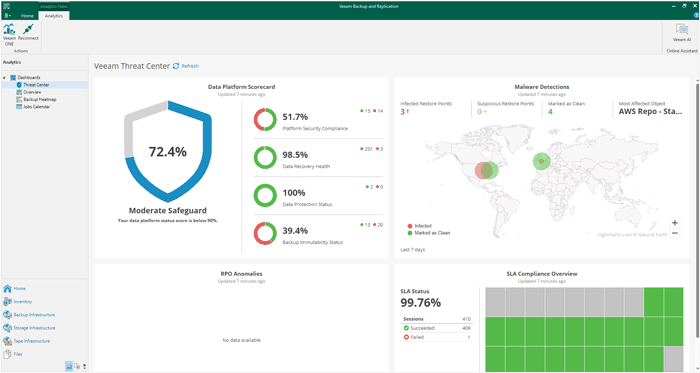
Primarily focused on backup and disaster recovery for enterprise environments, Veeam ensures that if data is lost, a secondary copy is always ready to be restored with minimal downtime.
Key features:
Restore a failed virtual machine to a production environment in minutes by running it directly from the backup file.
Ensure backups are "write-once-read-many" (WORM) to protect against ransomware encryption.
Allow for the easy migration and recovery of laptop workloads to AWS, Azure, or Google Cloud.
Pros:
Enterprise-grade reliability.
Excel at "Instant Recovery" for virtual machines and entire servers.
Include built-in ransomware protection.
Cons:
Overkill for individual file recovery.
Complex licensing and setup that usually requires an IT administrator.
High cost for small-scale use.
License pricing:
Starts at approximately $89.20 per license/year (MSRP).
1.12 RecoveryFox AI
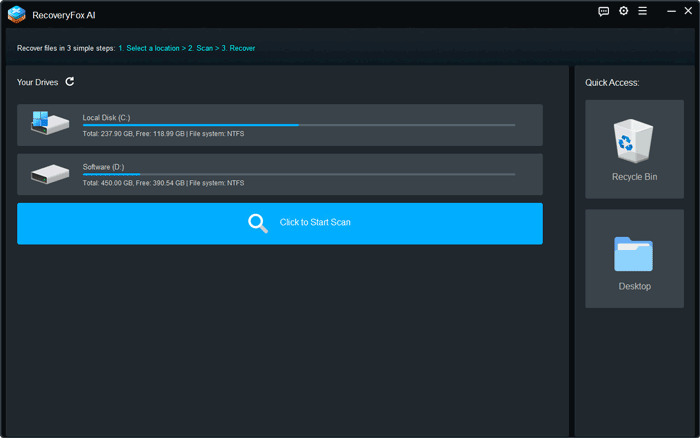
A newer entry to the market, RecoveryFox AI utilizes machine learning to optimize scanning patterns. It aims to reduce "noise" in scan results, helping users find the specific files they need faster than traditional methods.
Key features:
Claim to use machine learning to identify and reconstruct file fragments that traditional algorithms might miss.
Prioritize maintaining original file names and the exact hierarchical folder structure during the export process.
Feature a modern, minimalist interface designed for quick filtering by file date, size, or extension.
Pros:
Use AI algorithms to intelligently reconstruct partially overwritten files.
Simple one-time payment model with no recurring fees.
Modern interface and automated recovery process.
Cons:
Newer tool with less market reputation.
Currently lack a macOS version.
No integration with cloud storage.
License pricing:
One week: $49.95
One month: $59.95
One year: $69.95
Lifetime: $99.95
Part 2: FAQs About Laptop Data Recovery Software
Q1: How to select a suitable laptop data recovery software app?
When choosing a laptop data recovery tool, consider the following factors:
Compatibility: Make sure the software supports your operating system (Windows or macOS).
File type support: Different tools support different file formats. Choose one that can recover the files you need.
Recovery performance: Look for software that offers deep scanning and high recovery success rates.
Ease of use: If you are not a technical user, select software with a simple interface and guided recovery steps.
Price and trial version: Many programs provide free trials that allow you to scan and preview recoverable files before purchasing.
Q2: Is it safe to use data recovery software on my laptop?
Generally, yes, provided you follow one golden rule: Never install the software on the same drive you are trying to recover. Doing so can overwrite the very data you want to save. Always run the software from an external drive or a different partition.
Q3: Can data be recovered from SSDs?
Recovery from SSDs is more challenging than traditional HDDs due to a feature called TRIM. When a file is deleted on an SSD with TRIM enabled, the drive often wipes the data blocks immediately to maintain speed. However, if the drive was disconnected quickly or TRIM was disabled, recovery is still possible using professional tools.
Conclusion
Data loss can happen unexpectedly, but the right laptop data recovery software can significantly improve the chances of retrieving lost files. Tools like Coolmuster Data Recovery, Disk Drill, Recuva, EaseUS Data Recovery Wizard, and others offer a variety of features designed to handle different data loss scenarios.
By understanding the available options and best practices, you can protect your valuable data and recover important files when unexpected problems occur.






 Free Download for PC
  Free Download for Mac


