TL;DR: Want to compress audio files without losing quality? This guide covers the best ways to reduce audio size on Windows, Mac, online, Android, and iPhone. Learn how to compress MP3, WAV, FLAC, and other formats using professional software, free tools, online compressors, and mobile apps while keeping clear sound quality.
Audio files are widely used for music, podcasts, voice recordings, online courses, and video projects. However, high-quality audio formats such as WAV, FLAC, and high-bitrate MP3 files can quickly take up storage space and become difficult to upload, share, or send through messaging platforms. This is where compressed audio methods become useful. By reducing the size of an audio file through audio compression, you can save storage space, speed up file transfers, and make audio easier to share without significantly affecting sound quality.
Whether you want to compress an audio file to 10 MB, compress an audio file to 14 MB, compress an audio file to 16 MB, or simply reduce the overall compressed audio size, there are many solutions available. In this guide, we will explain how to compress audio files on Windows, Mac, online platforms, and mobile devices.
Compressing audio refers to the process of reducing the size of an audio file by removing unnecessary data or optimizing audio parameters. During audio compression, tools usually adjust settings such as bitrate, sample rate, audio format, and channels to make the file smaller. There are two main types of audio compression:
1. Lossy Audio Compression
Lossy compression reduces file size by removing audio data that most listeners cannot easily notice. This method provides much smaller files but may slightly reduce sound quality.
Common lossy formats include:
Lossy compression is ideal when you need to:
2. Lossless Audio Compression
Lossless compression reduces file size while preserving all original audio information. It provides better quality but usually does not achieve the same size reduction as lossy formats.
Common lossless formats include:
Lossless compression is commonly used for:
For users who frequently work with audio files, desktop software is usually the most flexible way to perform audio compression. Below are three practical ways to compress audio files on a computer.
If you need to quickly compress audio while controlling the output quality, format, and file size, professional audio and video processing software can be a great choice. Video Converter Ultimate supports both Windows and Mac systems. In addition to audio format conversion, it also provides an audio compressor feature to help reduce the file size of MP3, WAV, FLAC, AAC, and other audio files. It is ideal for users who need to process audio files in batches, adjust audio parameters, or maintain high sound quality.
Key features of Video Converter Ultimate:
How to compress audio files without losing quality:
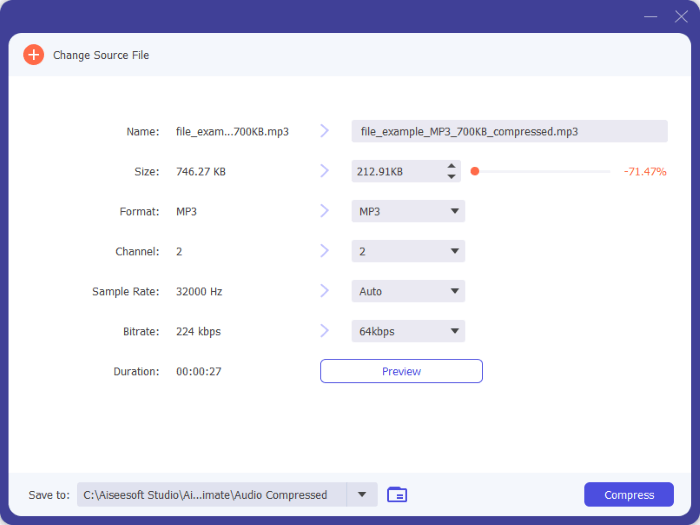
01Download and install Video Converter Ultimate on your computer. Open the program, go to the "Home" tab, and select "Audio Compressor" under the "Audio" section.
02Upload the audio file you want to compress. Adjust the compression level with the slider to reduce the file size. You can also customize settings such as output format, file name, channel, sample rate, and bitrate for better results.
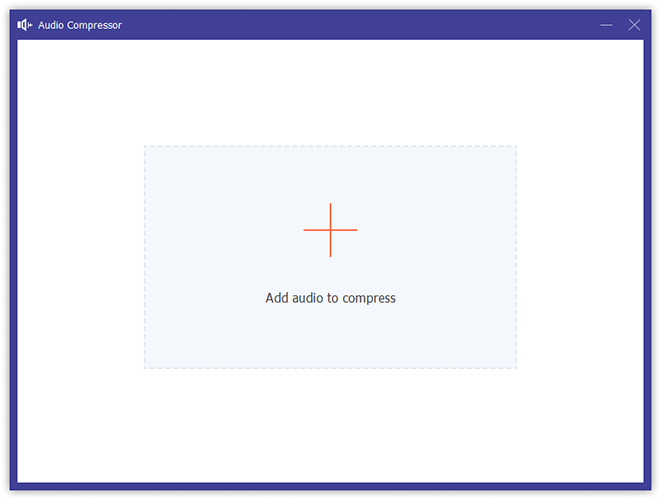
03Select a destination folder for the compressed audio file. Click the "Compress" button to start the process and get a smaller audio file with the desired quality.
For users who need more than simple compression, Audacity is another popular choice. Audacity is a free, open-source audio editing program available for Windows, Mac, and Linux.
Instead of only reducing file size, Audacity allows you to edit audio before compression. You can remove unwanted sections, reduce background noise, adjust volume, and then export a smaller audio file.
Here is how to compress an audio file for free using Audacity:
Step 1. Open Audacity, go to "File" > "Open", and select your audio file to import it.
Step 2. Optional: Trim silent sections or use "Effect" > "Volume and Compression" > "Compressor" to adjust audio volume.
Step 3. Go to "File" > "Export Audio".
Step 4. Choose "MP3" Files as the export format.
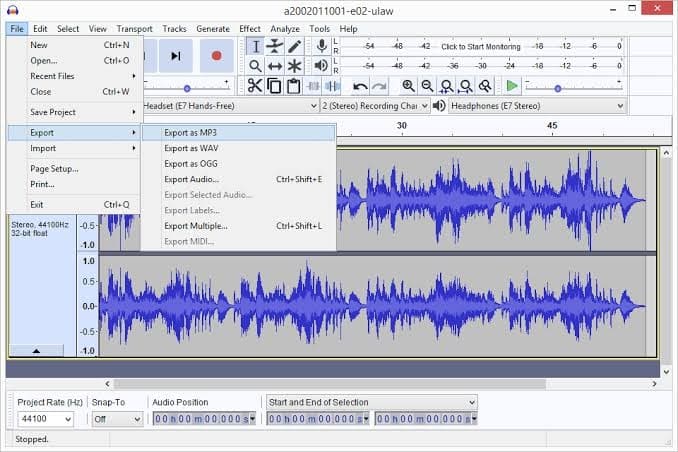
Step 5. Configure audio settings: pick "Mono" for voice or "Stereo" for music, and set the sample rate and bitrate.
Step 6. Name your file and select a save folder.
Step 7. Click "Export", edit metadata if needed, and confirm.
Step 8. Wait for encoding to finish; you will get the compressed audio file.
For users who already have a media player installed on their computer, VLC can also work as a simple audio compression solution. VLC Media Player is widely known for playing almost all types of video and audio files, but it also includes a conversion feature that allows users to reduce audio file size.
Compared with professional audio compressors, VLC provides fewer customization options. However, it can still be useful when you only need to convert an audio file into a smaller format or lower the bitrate without installing additional software. (How to compress a video using VLC?)
Here is how to compress an audio recording using VLC Media Player:
Step 1. Open VLC Media Player and go to "Media" > "Convert/Save".
Step 2. Click "Add" to import the audio recording, then click "Convert/Save".
Step 3. Select "Audio - MP3" from the "Profile" drop-down menu.
Step 4. Click the profile settings icon, open "Audio codec", and lower the bitrate. Use 128 kbps for a good balance, or 64–96 kbps for smaller voice recordings.
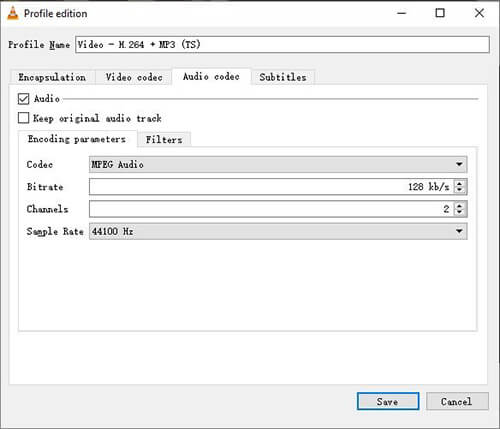
Step 5. Click "Browse" to choose a save location and enter a filename ending in .mp3.
Step 6. Click "Start" to convert and compress the audio file.
Installing software is not always convenient, especially when you only need to compress one or two small audio files. In these situations, an online audio compressor can provide a faster solution. Online tools allow users to upload an audio file, adjust compression settings, and download the smaller version directly from a browser. However, online compression tools usually depend on internet speed and may have limitations on file size or supported formats. For users handling large audio recordings, desktop software may provide a more stable experience.
XConvert is an online file processing platform that supports audio compression. It allows users to reduce audio file size without installing additional programs.
Here is how to compress audio online via XConvert:
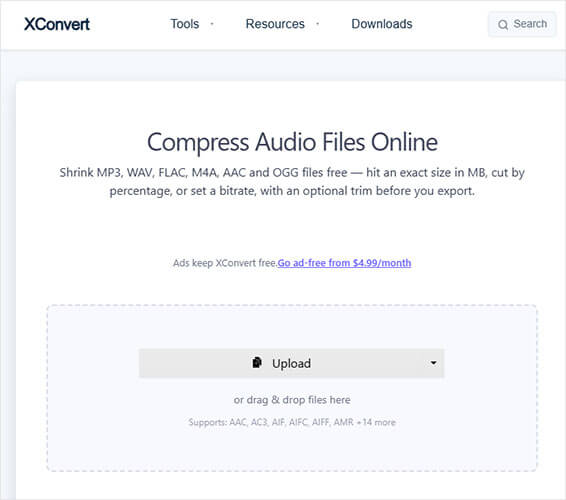
Step 1. Go to the XConvert Audio Compressor website and click "Upload" to select the audio file you want to compress from your computer.
Step 2. Click the "Compress" button to start reducing the audio size. XConvert will start compressing your audio files.
Step 3. When the compression is finished, click "Download" to save the smaller audio file to your device.
Many users store large numbers of audio files directly on their smartphones, including voice recordings, downloaded music, podcasts, and audio files from messaging apps. Over time, these files can take up a significant amount of storage space. Using a mobile audio compressor is a convenient way to reduce file sizes without having to transfer files to a computer.
Below are two commonly used audio compression apps for Android and iPhone.
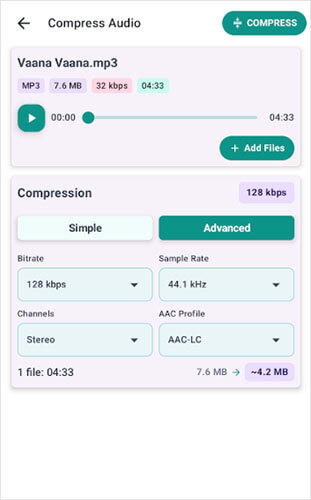
Audio Compressor - MP3 Reducer is an audio compression tool for Android. It supports common formats such as MP3, WAV, AAC, FLAC, M4A, OGG, OPUS, and WMA. The app offers both simple and advanced compression modes, allowing users to reduce audio file sizes by adjusting the bitrate, sample rate, and mono/stereo settings. It also supports batch compression and offline processing, making it suitable for compressing voice recordings, podcasts, and audio files that need to be shared via WhatsApp, email, and other platforms.
Here is how to compress audio files on an Android phone using Audio Compressor - MP3 Reducer:
Step 1. Open the Audio Compressor - MP3 Reducer app on your Android phone and go to the "Compress Audio" page.
Step 2. Tap "+ Add Files", then select the audio file you want to compress from your phone storage.
Step 3. Choose a compression mode, "Simple" or "Advanced", and then set advanced audio parameters.
Step 4. Tap the top-right "COMPRESS" button to start audio compression.
Step 5. Wait for the process to finish, then save the compressed audio to your Android device.
Audio Compressor - MP3 Shrink is an audio compression tool for iPhone and iPad. It reduces audio file sizes by adjusting the bitrate and removing unnecessary metadata while aiming to preserve sound quality. The app allows users to select audio files from their devices for compression or extract and compress audio from videos. The entire compression process can be completed locally and offline on the device, making it suitable for users who want to save storage space or reduce audio file sizes for easier sharing.
Here is how to compress an audio file on iPhone using Audio Compressor - MP3 Shrink:
Step 1. Launch the Audio Compressor - MP3 Shrink app on your iPhone and open the "Compress Audio" page.
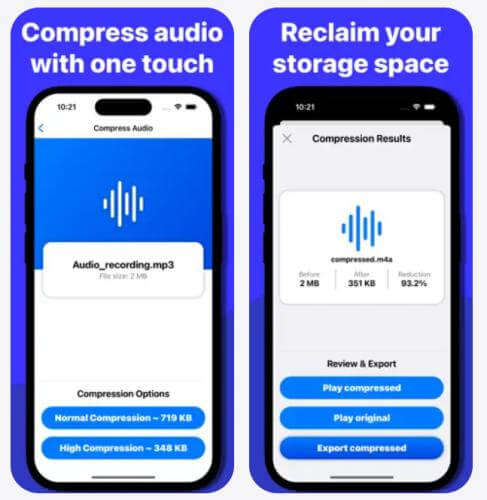
Step 2. Import your target audio file. The app will display the original file size.
Step 3. Select a compression preset: "Normal Compression" or "High Compression".
Step 4. The app processes the audio and opens the "Compression Results" screen. It shows the original size, compressed size, and storage reduction percentage.
Step 5. Tap "Play compressed" to listen to the newly compressed file or tap "Play original" to compare with the unmodified audio
Step 6. Tap "Export compressed" to save the compressed audio file to your iPhone.
Compressing audio files can effectively save storage space and make audio easier to upload and share. For basic needs, Audacity, VLC, or the online tool XConvert can handle simple audio compression. Mobile users can use Audio Compressor - MP3 Reducer or Audio Compressor - MP3 Shrink to quickly process audio files.
If you need more consistent compression, advanced parameter controls, and batch processing, Video Converter Ultimate is worth considering. It supports a wide range of audio formats and allows you to adjust the file size, bitrate, and output settings, making it easy to compress audio while maintaining good sound quality.
Related Articles:
How to Compress WAV Files Without Losing Audio Quality in 2026
3 Effective Methods to Compress Video for Web Easily and Quickly
[Full Guide] How to Compress Files on Windows/Mac/Android/iPhone?




 Free Download for PC
  Free Download for Mac


