AirDrop and SHAREit are two popular file transfer tools, but they serve slightly different purposes and work in different ecosystems. AirDrop, developed by Apple, allows seamless file sharing between Apple devices, offering a fast and secure transfer experience within the Apple ecosystem. On the other hand, SHAREit is a cross-platform app that supports file sharing between Android, iOS, and even Windows devices, making it versatile but sometimes less secure.
In this article, we'll compare AirDrop and SHAREit in terms of functionality, ease of use, and compatibility to help you decide which tool is better suited for your needs.
AirDrop is a built-in feature on iOS devices and macOS that allows users to share files between multiple devices using Wi-Fi or Bluetooth. By simply dragging a file to the specific profile picture of a recipient who has AirDrop enabled, you can perform a one-to-one file transfer.
However, since AirDrop was introduced with iOS 7, earlier versions of iOS (before the iPhone 5) do not support this feature. Before using AirDrop, it's important to ensure that your device is compatible with the function.
What's SHAREit?
SHAREit is a cross-platform file transfer tool that enables users to send a variety of files - such as photos, videos, apps, and contacts - between devices, including mobile phones, tablets, PCs, and Macs. SHAREit uses a Wi-Fi connection for file sharing.
Unlike AirDrop, SHAREit is not pre-installed. You can download it for free from the Google Play Store or other app stores. To share files with SHAREit, you need to open the app and initiate the transfer from within the app itself, unlike AirDrop, which allows you to directly enable file sharing from the control panel.
Part 2: How to Use AirDrop and SHAREit?
1. How to Use AirDrop?
To share files using AirDrop, the sender and receiver need to be in close proximity. Once you're near the recipient, follow these steps to share files using AirDrop on your iPhone, iPad, iPod, or Mac:
Step 1. Turn on Bluetooth and Wi-Fi on both your Mac and iOS device.
Step 2. Select the files you want to share (photos, videos, contacts, etc.) from the relevant app or folder.
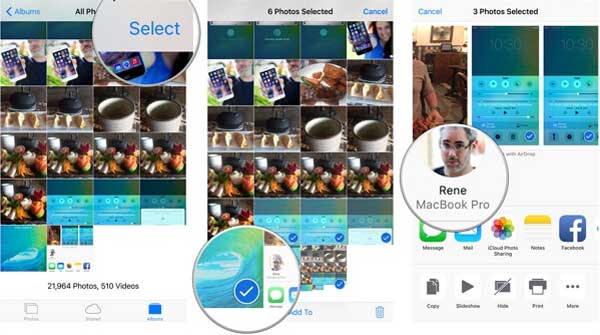
- On iPhone, iPad, or iPod: To share photos, open the "Photos" app > "Albums" and tap the "Select" option to choose the desired pictures. Tap the Share icon, then select "AirDrop" and choose the nearby AirDrop user or Apple device. The selected photos will be sent to the recipient.
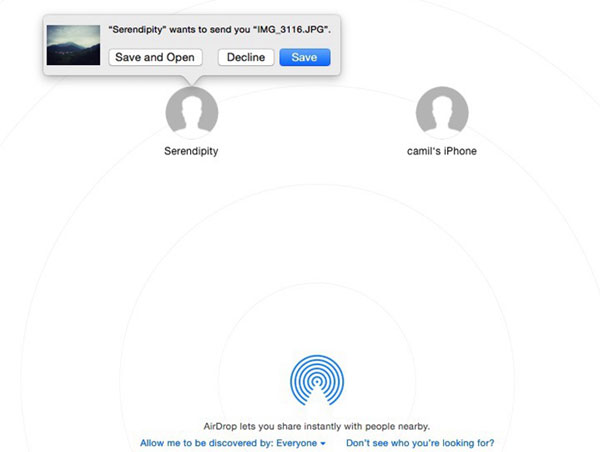
- On Mac: Open AirDrop by clicking "Finder" > "Go" > "AirDrop." You will see a list of nearby AirDrop users. Drag the files you want to send to the recipient's avatar and click "Send" to start the transfer.
2. How to Use SHAREit?
Since SHAREit is not pre-installed, you'll need to download and install it on both the sender's and receiver's devices from the Google Play Store (for Android) or the App Store (for iOS).
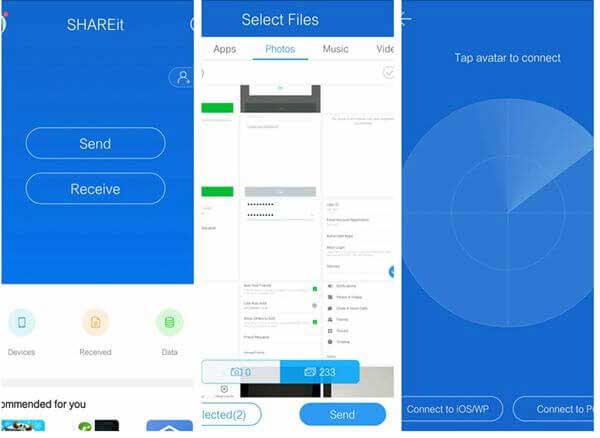
Step 1: Launch the SHAREit app on both devices. On the main screen, you'll see two options: "Send" and "Receive."
Step 2: To send files, tap the "Send" option and choose the files (such as apps, photos, music, videos, etc.) that you want to share.
Step 3: Tap the "Send" button again. SHAREit will search for nearby users. Select the recipient's avatar to begin the transfer. For the receiver, tap "Receive" to accept the incoming files.
Part 3: Key Differences between AirDrop and SHAREit
While both AirDrop and SHAREit are popular file-sharing tools, they differ significantly in several key areas. Here's a breakdown of their main differences:
1. Compatibility
AirDrop: AirDrop is exclusive to Apple devices, including iPhone, iPad, iPod touch, and Macs. It works seamlessly within the Apple ecosystem but is not available for Android or Windows devices. (How to Fix AirDrop on Mac Is Not Working?)
SHAREit: SHAREit is a cross-platform tool, supporting Android, iOS, Windows, and even macOS devices. It allows file sharing between various operating systems, making it more versatile than AirDrop.
2. Ease of Use
AirDrop: AirDrop is built into Apple devices, so no installation is needed. Users can activate it directly from the control center on iOS devices or from the Finder on Macs. Sharing is straightforward, requiring only the selection of files and choosing the nearby recipient.
SHAREit: SHAREit requires downloading and installing the app from Google Play Store or the App Store. Once installed, users must open the app and select "Send" or "Receive," making it slightly more cumbersome than AirDrop.
3. File Types and Transfer Range
AirDrop: AirDrop supports the sharing of a variety of file types, including photos, videos, documents, contacts, and more. However, the transfer range is typically limited to the immediate vicinity (around 30 feet), and both devices must have Bluetooth and Wi-Fi enabled.
SHAREit: SHAREit supports a broader range of file types, including apps, photos, music, videos, and documents. It uses Wi-Fi to transfer files, which allows it to offer faster transfer speeds over longer distances, typically up to 100 feet or more in ideal conditions.
4. Internet Connection Requirement
AirDrop: AirDrop does not require an internet connection for file sharing. It uses Bluetooth to establish a connection and Wi-Fi to transfer files.
SHAREit: SHAREit does not need an internet connection either, as it uses Wi-Fi Direct to connect devices. This allows for file sharing even in places without Wi-Fi networks.
5. Security
AirDrop: AirDrop uses end-to-end encryption to secure file transfers, ensuring that the shared files cannot be intercepted or viewed by unauthorized parties. Since AirDrop works within a closed ecosystem (Apple), it is generally considered more secure.
SHAREit: SHAREit, while encrypted, has faced some security concerns in the past, particularly related to vulnerabilities and the potential for malware. However, recent updates have improved its security measures, although it may not be as robust as AirDrop in terms of privacy.
6. Cost
AirDrop: AirDrop is completely free to use and comes pre-installed on Apple devices, so there are no additional costs or hidden fees involved.
SHAREit: SHAREit is free to download and use. However, it contains ads, and users can choose to remove them through in-app purchases or subscriptions, which could be a downside for some users.
7. Availability
AirDrop: AirDrop is only available for Apple devices. Users with Android or Windows devices are not able to use this feature (How to AirDrop from iPhone to Windows PC?).
SHAREit: SHAREit is available on Android, iOS, Windows, and macOS devices, making it a versatile option for users who frequently exchange files across different platforms.
Part 4: AirDrop and SHAREit: Pros & Cons
AirDrop:
Pros:
AirDrop is fully integrated within the Apple ecosystem, making it incredibly easy to use for iPhone, iPad, and Mac users.
AirDrop uses end-to-end encryption, ensuring your files are transferred securely.
Doesn't require an internet connection; it uses Bluetooth and Wi-Fi to transfer files locally.
For smaller files, AirDrop offers quick and efficient transfers.
Cons:
AirDrop is exclusive to Apple devices, so it cannot be used to transfer files to or from Android or Windows devices.
AirDrop has a relatively short transfer range (about 30 feet), which may limit its usability in larger spaces.
In some cases, the connection between devices can be spotty, especially if there are obstacles or interference.
SHAREit:
Pros:
SHAREit works across multiple platforms, including Android, iOS, Windows, and macOS, making it versatile for users with different devices.
SHAREit typically offers faster transfer speeds, especially for large files, as it uses Wi-Fi Direct.
Like AirDrop, SHAREit doesn't need an active internet connection to transfer files.
SHAREit is free to download and use, although it has ads.
Cons:
SHAREit includes ads, which can disrupt the user experience unless you opt for a paid version to remove them.
There have been past security issues with SHAREit, including potential vulnerabilities and concerns about malware.
Unlike AirDrop, SHAREit is not pre-installed, and both devices need the app to be downloaded, which can be a hassle for users who prefer a more straightforward solution.
Bonus: An Alternative Way to Transfer Data between Two Devices
If you're looking for a simple and reliable way to transfer data between devices, Coolmuster Mobile Transfer is an excellent alternative to AirDrop and SHAREit. It supports seamless transfers between different devices, whether you're moving data from an old phone to a new one or transferring files across platforms. With its user-friendly interface, you can easily manage your data transfer needs.
Key Features of Coolmuster Mobile Transfer::
Transfer data between Android, iOS, even from iOS to Android devices, and vice versa.
Move your photos, videos, contacts, messages, and more with just one click.
Ensures safe and complete data transfer with no risk of data loss.
Easy-to-use interface that simplifies the entire transfer process.
Compatible with all iPhone series and Android brands.
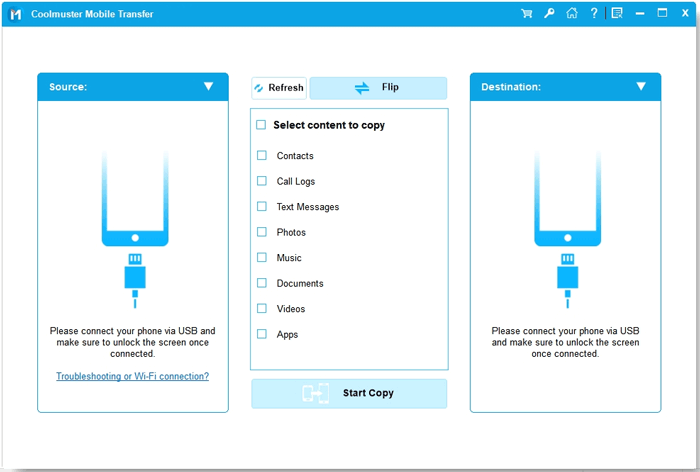
01 Download and install Coolmuster Mobile Transfer on your computer. Launch the program and connect both your source and destination devices to the computer using USB cables.
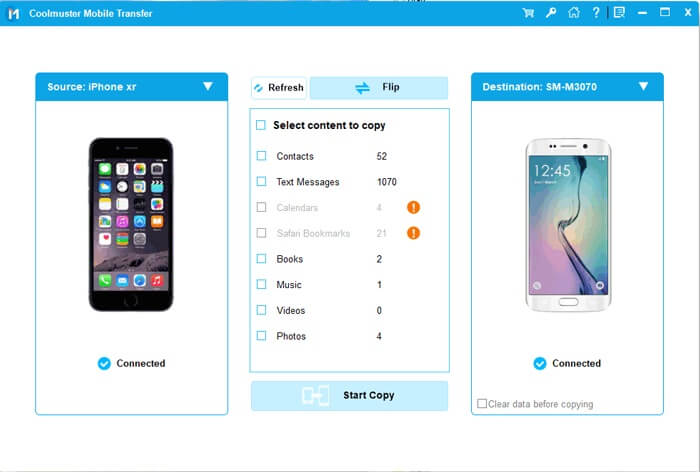
02 Once the devices are connected, check to ensure the souce device is the phone that you want to transfer data from, and the destination device is the phone you want to transfer data to. You can click "Flip" to switch them.
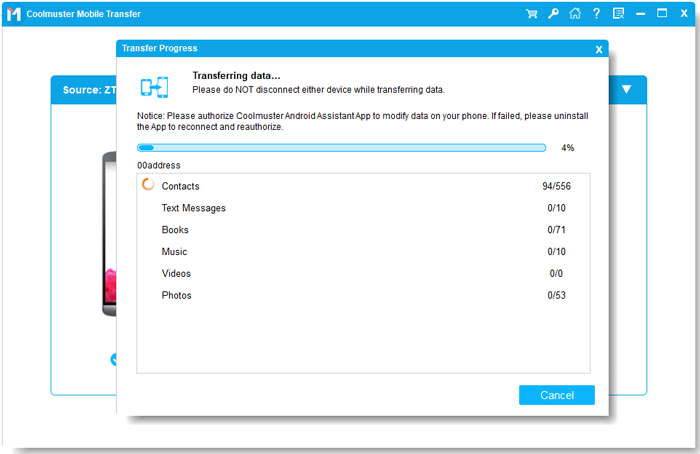
03 Select the type of data you want to transfer (e.g., photos, contacts, SMS). Click on "Start Copy" to initiate the transfer. Wait for the process to complete, and your data will be transferred successfully between the devices.
Video Guide:
Conclusion: AirDrop & SHAREit: Which is Better?
Choosing between AirDrop and SHAREit depends on your needs and the devices you use.
Choose AirDrop if:
You're using Apple devices:AirDrop is built into iPhones, iPads, and Macs, making it quick and easy to use.
You want secure transfers: AirDrop uses end-to-end encryption, ensuring your files are safe.
You're transferring small files: AirDrop is perfect for quickly sharing photos, videos, and contacts.
Choose SHAREit if:
You need cross-platform support: SHAREit works on Android, iOS, Windows, and macOS, so it's great for mixed devices.
You're transferring large files: SHAREit offers faster speeds for bigger files using Wi-Fi Direct.
You're not using Apple devices: SHAREit is ideal for users with Android or Windows devices.
Conclusion:
AirDrop is best for Apple users who want a secure, quick, and easy file transfer experience.
SHAREit is better if you need to share files across different devices or need faster transfers for large files.






 Free Download for PC
  Free Download for Mac


